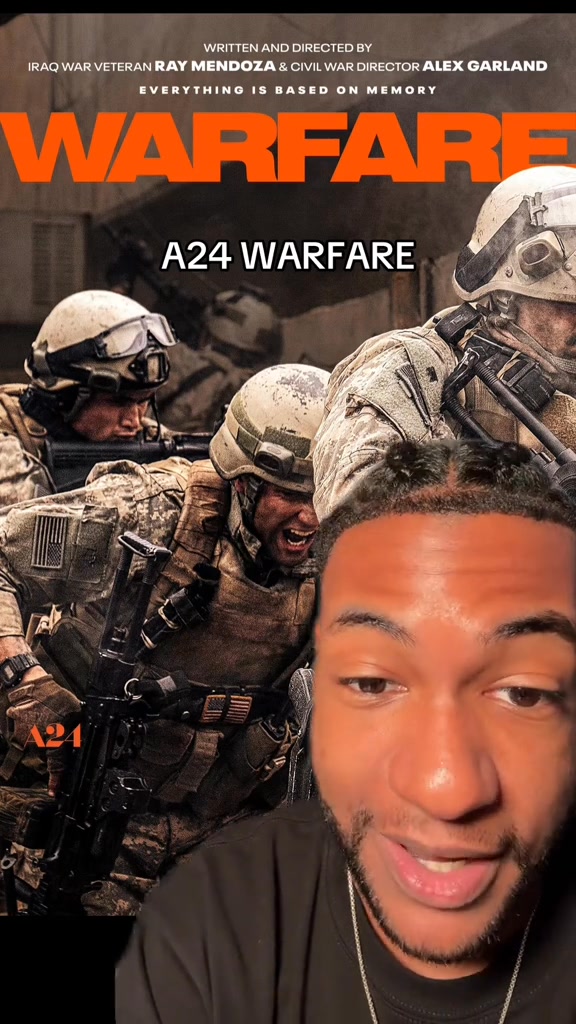
Is A24's "Warfare" Truly Anti-War? A Critical Look at its Message
A24 has carved out a unique niche in Hollywood, synonymous with thought-provoking, often genre-bending independent cinema. From psychological thrillers and unsettling horror (which might lead some to search for an "a24 backrooms movie" given their unsettling aesthetic) to profound dramas, their films consistently challenge audiences. Their 2025 release, "Warfare," plunges into the complexities of modern conflict, promising a raw and unflinching look at the Iraq War. But as the dust settles, a critical question emerges: does "Warfare" truly deliver on an anti-war message, or does it merely scratch the surface of a deeply problematic conflict?
Unlike some of A24's more abstract or horror-centric offerings, "Warfare" anchors itself in the grim realities of military operations. It attempts to expose the human cost and tactical blunders of America's post-9/11 engagements, a theme often fumbled by mainstream war films. However, a deeper dive into its narrative reveals a nuanced, and at times contradictory, stance on the very nature of war itself.
Beyond the Hype: Deconstructing "Warfare"'s Premise
"Warfare" centers on a U.S. Navy SEAL surveillance team secretly infiltrating an Iraqi urban residential building. Their mission: to establish an observation post, a critical link between two larger American units (A1 and B1) tasked with clearing resistance strongholds in the surrounding area. The premise immediately sets up a familiar scenario in modern war narratives: a small, elite unit operating in a hostile environment, often depicted as a testament to American military prowess.
However, the film quickly subverts this expectation. Shortly after the SEALs are in position, they receive word that units A1 and B1 have completed their "clearance" missions and are withdrawing. This unilateral withdrawal leaves the observation post dangerously isolated, turning their tactical advantage into a perilous vulnerability. Unit B1, in its retreat, is ambushed, diverting the critical aerial drone support that was meant to safeguard the SEALs. Overnight, the observation team, initially a strategic asset, becomes a vulnerable target, surrounded and outgunned by Iraqi resistance fighters. This stark scenario echoes critiques seen in other films like A24's "Warfare": Unpacking US Military Blunders in Iraq, where tactical missteps lead to catastrophic outcomes.
This opening gambit immediately challenges a prevailing trope in many American war films of the new millennium: the tendency to "turn defeat into victory" or to downplay strategic failures. The narrative of "Warfare" directly confronts this, presenting a situation where the US military's operational plan is fundamentally flawed, leaving its own soldiers in dire straits. It brings to mind films like "The Outpost," which similarly depicted a US base in a geographically indefensible position, highlighting the consequences of poor strategic planning and overconfidence.
The Perilous Price of "Progress": Iraqi Lives and Strategic Blind Spots
Perhaps the most damning critique leveled against "Warfare" and its anti-war credentials lies in its portrayal of local allies and non-combatants. The film meticulously details the perils faced by the SEALs but seems to falter when it comes to the broader implications of their presence. A pivotal scene illustrates this: when Bradley fighting vehicles arrive to support the SEALs, Iraqi National Army (INA) soldiers are ordered to advance first. Predictably, two INA soldiers are killed by an Improvised Explosive Device (IED), their bodies tragically torn apart, paving the way for the American troops.
This sequence draws a poignant parallel to a scene from the Chinese anti-Japanese war comedy "Underground Traffic Station," where a captured soldier, Wu Fugui, exposes the Japanese military's tactic of sending collaborators to clear mines or shield their advances. The reference text provocatively asks: "Did this film pay tribute to the Iraqi soldiers? No." If not for their sacrifice, the SEAL team might have been entirely wiped out. This suggests that "Warfare," while portraying the suffering of US soldiers, implicitly normalizes the disposability of local lives for American objectives, undermining a truly anti-war stance.
Further eroding its claim to anti-war profundity is the depiction of seemingly gratuitous violence against Iraqi civilians. In one instance, a rooftop of an Iraqi resident's home is bombed with a Claymore mine, not because it housed combatants, but simply as a display of force. An Iraqi woman's repeated, anguished cry of "Why, why, why?" goes unanswered, highlighting the arbitrary destruction and lack of accountability that characterized parts of the conflict. Such acts, coupled with the SEALs' noisy, prolonged efforts to create firing positions inside the building – seemingly oblivious to the risk of detection – paint a picture of operational carelessness that borders on contempt for the local environment and its inhabitants. The film, in these moments, feels less like a critique of war and more like a high-stakes video game, where collateral damage is an unfortunate, yet accepted, byproduct of mission objectives.
A Critical Lens on Command: When Plans Collapse in "Warfare"
Where "Warfare" truly shines as a critical piece is in its excoriation of US military leadership and strategic planning. The film meticulously outlines a cascade of command failures that doom the observation team:
- Rigid Adherence to Flawed Plans: The observation post is established between A1 and B1, but these units withdraw almost immediately. The command, failing to adapt to real-time changes, proceeds with a plan that has become obsolete, leaving the SEALs stranded.
- Lack of Situational Awareness: Despite advanced surveillance equipment, the SEALs are blindsided by the approaching resistance. Drones are diverted, listening devices fail, and the team is caught off guard, highlighting a disconnect between technological superiority and effective intelligence gathering.
- Failed "Force Projection": Repeated low-altitude flyovers by aircraft, intended as "force deterrence," prove ineffective. Instead of intimidating the resistance, they seem to embolden them, leading to counter-attacks and the observation team being "enveloped like dumplings."
The film argues that the US military, in its modern iteration, struggles with effective "garrison warfare" or "peacekeeping operations." Its inability to secure flanks, ensure coordinated withdrawals, or adapt plans on the fly leads to tragic outcomes reminiscent of historical blunders, such as the encirclement during the Battle of the Bulge in WWII. This point of view, elaborated further in "Warfare" Exposes Why US Military Tactics Fail in Modern Combat, suggests a systemic issue rather than isolated incidents.
The director, according to the reference text, is "cursing at officials" while simultaneously affirming the bravery of the individual soldiers on both sides. The SEALs, though outmaneuvered, display courage and resilience in defending their position. Even the Iraqi resistance fighters are portrayed with a certain bravery, limited primarily by their lighter weaponry and caution due to potential hostages within the building. This distinction is crucial: it’s not the soldiers who are failing, but the system and the leadership that put them in impossible situations. The film implicitly critiques the US military's strategic doctrine, drawing parallels to modern conflicts where similar mistakes—like the isolated and ultimately doomed advances of some Ukrainian units against well-prepared Russian defenses—underscore the timeless lessons of warfare: secure your flanks, adapt to the enemy, and never underestimate the resolve of a defending force.
Is "Warfare" Truly Anti-War? A Nuanced Verdict
So, does "Warfare" stand as a truly anti-war film? The answer is complex. It successfully exposes the tactical ineptitude and strategic blind spots of the US military, criticizing its leadership and the devastating consequences for soldiers caught in the crossfire. It vividly portrays the chaos, fear, and human cost of modern urban warfare. In this sense, by stripping away the glory and highlighting the sheer futility and absurdity of certain military operations, it leans towards an anti-war message.
However, its anti-war stance is arguably superficial because it largely avoids grappling with the fundamental *nature* or *justification* of the war itself. The film focuses heavily on *how* the war is fought poorly, rather than *why* it is being fought or the broader geopolitical implications. By failing to deeply question the motives behind the conflict, or the systemic issues that lead to the "disposable" treatment of local populations, it risks becoming an "anti-war" film that inadvertently normalizes the premise of intervention while critiquing its execution. As the source text suggests, to be anti-war without addressing the conflict's nature is "hooliganism" – a mere theatrical gesture rather than a profound ethical statement.
While "Warfare" offers a sobering look at the ground-level realities and the operational failures of modern conflict, its impact as a comprehensive anti-war statement remains debatable. It excels in showing the *misery* of war but perhaps stops short of challenging the *morality* of it with sufficient depth. This aligns with A24's general approach of presenting challenging narratives that invite interpretation, rather than didactic pronouncements. Ultimately, "Warfare" provides a powerful, albeit incomplete, piece of the anti-war puzzle, leaving viewers to ponder the deeper questions it raises but doesn't fully answer.